Legions · The legions, by number
12 Legio III Augusta
The Third Augustan Legion of Africa
Identity. Probably rooted in recruitment of 43 BCE. Its enduring imperial association was North Africa.
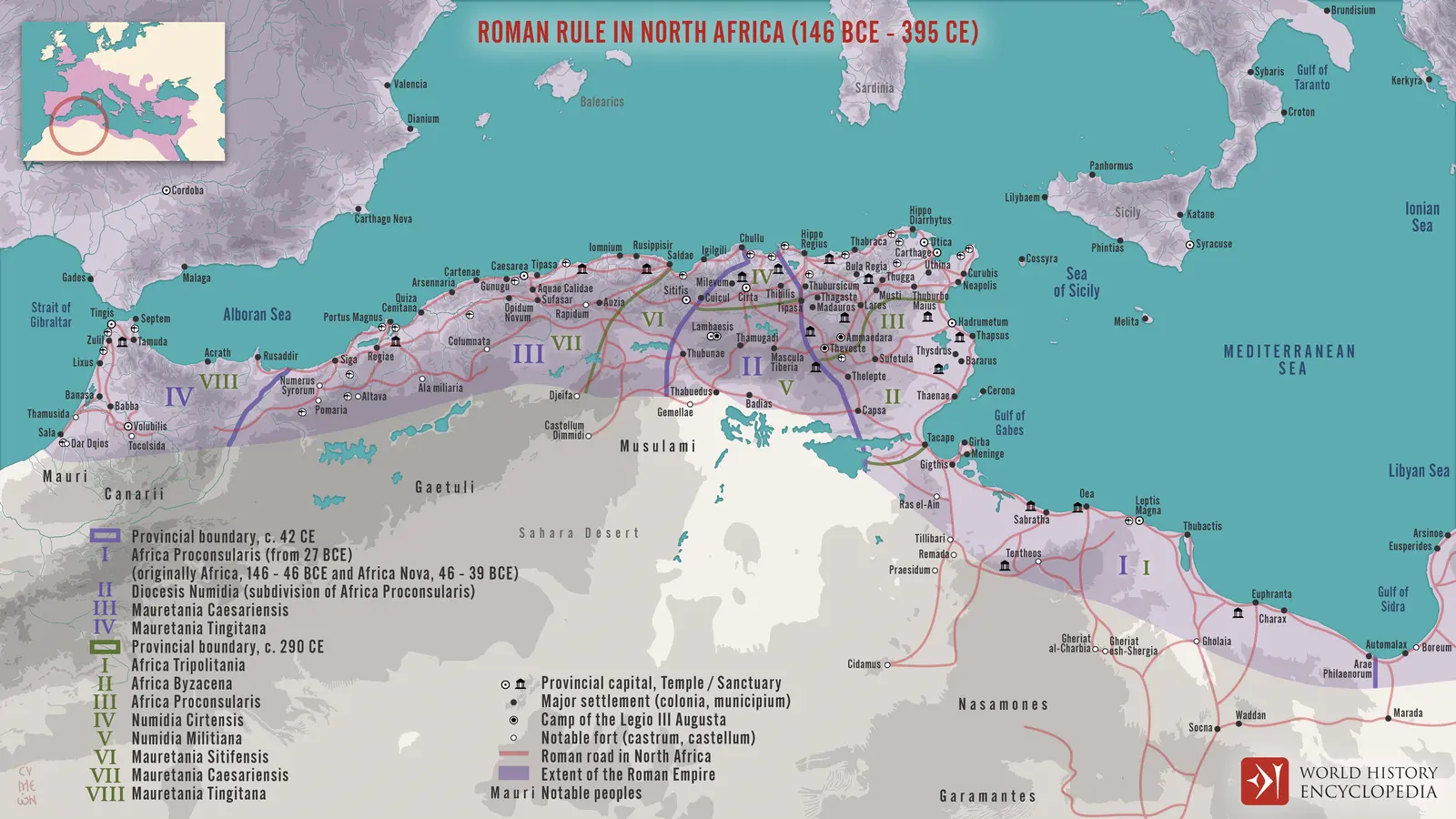
Historical outline. III Augusta’s long African residence made it a military institution with a regional history, not simply a regiment waiting for occasional battles. Its successive headquarters at Ammaedara, Theveste, and Lambaesis frame changing systems of occupation and communication. Its suppression in 238 and restoration under Valerian interrupt any uncomplicated narrative of continuous service.
Selected chronology
- Early empire: African garrison service and warfare against Tacfarinas, 17–24.
- Flavian–Hadrianic development: successive establishment at Theveste and Lambaesis.
- 238: intervention against the Gordian revolt; the legion was subsequently disbanded under Gordian III.
- 253: restoration under Valerian.
- Later third–fourth centuries: renewed African service; its precise final organizational fate remains uncertain.
The war against Tacfarinas
The conflict of 17–24 pitted the African military establishment against a coalition whose mobility and knowledge of the landscape made conventional victory insufficient. Tacfarinas had experience of Roman service and developed forces able to fight in different ways. A Roman success in one engagement did not remove the conditions that sustained resistance elsewhere.
III Augusta and its commanders faced raiding, dispersed opponents, difficult pursuit, and the need to protect communities and communications. Reinforcement by IX Hispana demonstrates that the African garrison could require help from outside its province. Severe punishment of Roman troops belonged to the command response; it was an instrument of coercion within the army, not evidence that Roman discipline operated without fear or conflict.
A chain of African headquarters
Ammaedara, Theveste, and Lambaesis trace the expansion and reorientation of military occupation. A headquarters was a center for administration, supply, training, and access to the surrounding road system. The move to Lambaesis brought the legion into a landscape where agricultural settlement, mountain routes, and the approaches to arid regions required different military responses. The frontier was a network of occupied places and communications rather than a perfectly sealed line across empty desert.
Hadrian’s inspection at Lambaesis in 128 made training itself an imperial occasion. The surviving address praises and assesses exercises, including the circumstances under which the troops performed them. It reveals military proficiency as something displayed, criticized, and maintained rather than assumed automatically from a regiment’s name.
Dissolution and restoration
The legion’s intervention against the Gordian rebellion in 238 had consequences beyond the immediate fighting. Its subsequent suppression removed an institution deeply rooted in African provincial life. Restoration under Valerian in 253 was thus a political and military reconstruction, not merely a change of emperor’s portrait in the headquarters shrine. Veterans, recruited manpower, and the recovery of corporate memory helped connect the restored regiment with its earlier history. III Augusta’s biography combines resistance to Roman occupation, provincial development, imperial politics, and a conspicuous institutional break.