Legions · The legions, by number
13 Legio III Cyrenaica
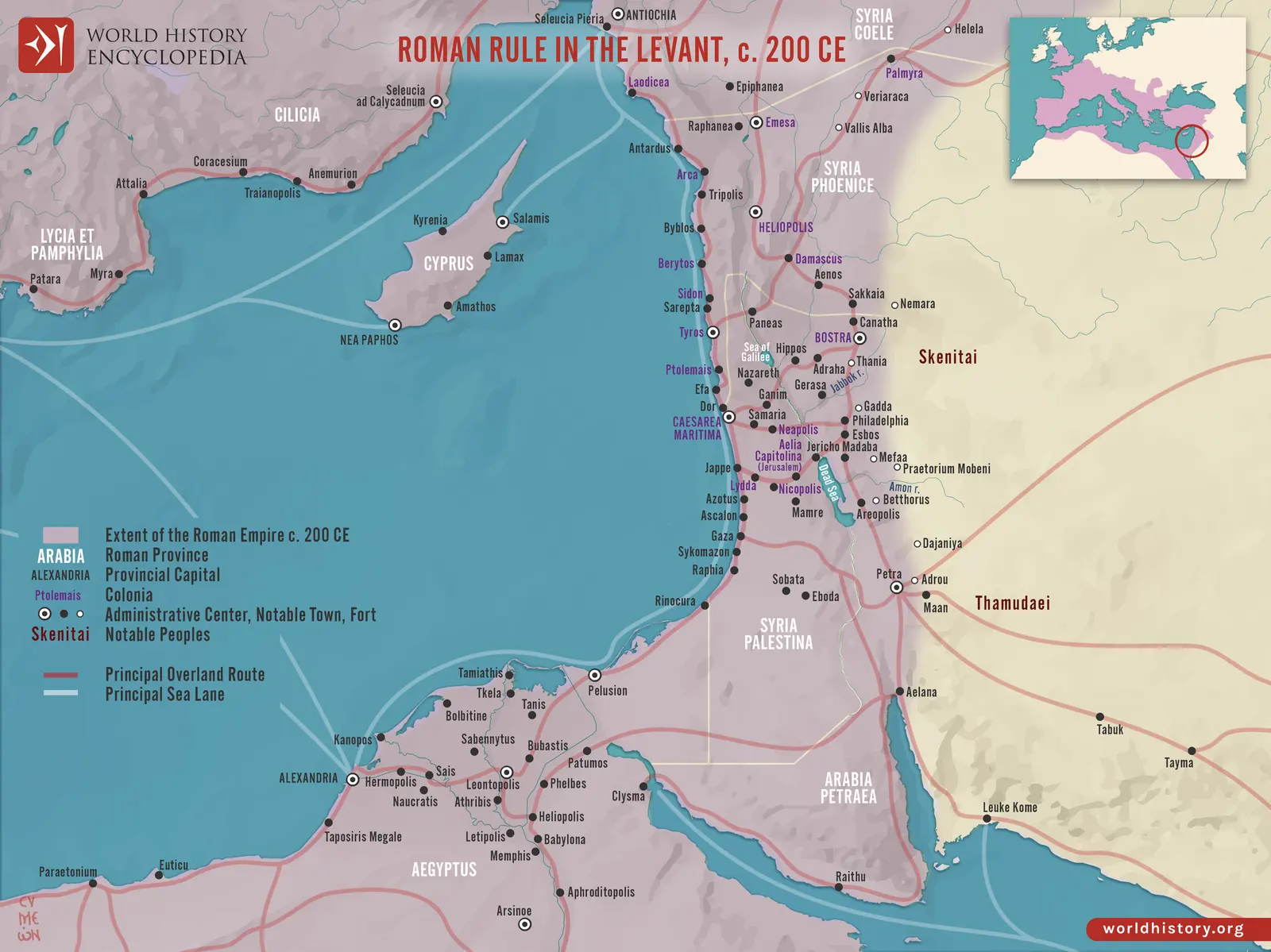
The Third served in Egypt, including the Alexandrian military establishment, before becoming associated with Roman Arabia and Bostra/Bosra. The transition involved deployments and returns rather than necessarily one clean move in 106. Its biography connects a Mediterranean provincial garrison with the roads and frontier posts of Arabia.
Endpoint: late Roman administrative survival at Bostra. Related identities: III Augusta in Africa and III Gallica in Syria.
Selected chronology
- 30 BCE onward: establishment within Roman Egypt.
- First century: Alexandrian garrison service alongside XXII Deiotariana.
- Early second century: deployments connected with the new province of Arabia.
- Later imperial period: enduring establishment at Bostra.
- Late Roman period: continued Arabian institutional identity.
The Alexandrian legion
III Cyrenaica’s obscure origins contrast with its substantial Egyptian life. The Alexandrian garrison occupied a province whose command arrangements and economic role were unusually important to the emperor. Urban politics, the protection of communications, and service elsewhere in Egypt formed part of the same military responsibility.
The regiment’s association with the god Ammon reflects its Egyptian environment. Soldiers could preserve corporate and Roman military traditions while participating in local religious life. The resulting identity was neither a timeless Italian uniformity nor a simple adoption of one provincial culture by every recruit.
Arabia and Bostra
The annexation of the Nabataean kingdom created a new provincial setting for Roman troops. Establishment in Arabia involved roads, forts, communications with neighboring provinces, and the maintenance of routes connecting settlements and trade. The movement of III Cyrenaica between Egypt and Arabia should not be simplified into one completely documented transfer on the date of annexation.
Bostra became its enduring center. From there the military landscape extended toward desert approaches and the wider eastern road system. Legionary infantry worked alongside cavalry, auxiliary formations, and regional forces suited to reconnaissance and dispersed security. The term “desert frontier” should not conjure an empty zone without towns, agriculture, movement, or local political relationships.
The third-century East and later survival
The rise of Palmyrene power and the Roman recovery under Aurelian altered authority in the region without erasing all existing military institutions. III Cyrenaica continued within this changing eastern world. The later addition of other regiments changed the distribution of responsibilities; the Third did not have to perform every task in Arabia by itself.
Its survival at Bostra preserves a durable provincial association. The surname Cyrenaica remained meaningful even when the regiment’s practical home had long been elsewhere. Its history connects client-kingdom incorporation, Egyptian administration, Arabian occupation, and late eastern continuity.