Wars · III. Mediterranean hegemony and its resistance
W029 The Sicilian servile wars
The first rising associated with Eunus and Cleon developed into a war that Roman forces could not suppress immediately. The second, associated with Salvius and Athenion, again required substantial Roman effort. Sicily's agricultural wealth and systems of enslavement were central conditions of the conflicts, not incidental background.
Mountain strongholds, estates, local towns and the movement of armed groups mattered. The rebels were not simply an undifferentiated crowd: the transmitted accounts describe leadership, religious authority and attempts at political organization. Roman military suppression restored the power of the owners and provincial authorities.
Command, forces and military problem
| Field | Dossier |
|---|---|
| Roman leadership | Rupilius in the first war; Aquillius in the second |
| Opposing or rival parties | Eunus and Cleon; later Salvius and Athenion |
| Forces and capabilities | Rebel armies with political leadership and strongholds against provincial and consular forces |
| Operational problem | Reduce fortified resistance in an island whose labor system helped generate the wars. |
First Sicilian war: leadership and strongholds
Eunus, who adopted the royal name Antiochus, and Cleon emerged as leaders of an uprising rooted in Sicily's systems of enslavement. Enna became a major center of rebel power. Their cooperation matters because Roman observers could expect rival leaders to destroy one another; the revolt instead sustained organization and resisted repeated intervention.
Roman suppression under Rupilius culminated in the reduction of strongholds, including Tauromenium and Enna. Defended towns and access to food were decisive to the struggle's duration. The revolt should therefore be visualized through settlements, estates, roads and mountain positions, not as one unstructured crowd wandering an island.
Diodorus' account survives through excerpts and later summaries. It combines condemnation of owners' treatment with hostile literary portraits of the rebel leaders. His emphasis on Eunus' religious performance is evidence of how leadership was represented, not direct access to everything the followers believed. The surviving Diodoran account supplies a useful external witness to the fragmentary tradition.
Second Sicilian war: a renewed provincial emergency
The rising of 104–100 BC developed in a different political moment, when Roman demands for military resources and disputes over the enslavement of people claimed as free interacted with the island's existing tensions. Salvius, who took the name Tryphon, and Athenion led major rebel forces. Their leadership and the stronghold at Triocala belong to a separate dossier phase, not a continuation of Eunus' personal rule.
Roman campaigns failed to suppress the movement immediately. Manius Aquillius eventually defeated the resistance. The outcome restored the owners' power through military force; it did not provide a general reform eliminating the conditions that made another revolt possible.
Military and social interpretation
The two wars show why the word "servile" must not be allowed to imply military insignificance. Enslaved laborers could organize, fortify, provision and defeat armies, while Roman officials could be constrained by the same property-owning elites whose practices intensified the crisis. The social violence and the campaigns are parts of one history.
Rebel numbers, named atrocities and the orderly appearance of kingship in elite narrative remain uncertain. The appropriate conclusion is neither that every dramatic story is true nor that the whole revolt can be reduced to its authors' stereotypes. The duration, Roman effort and political consequences establish the seriousness of both conflicts even where exact operations cannot be reconstructed.
Campaign geography and operational plates
Sicily: promontories, ports and the triangular island
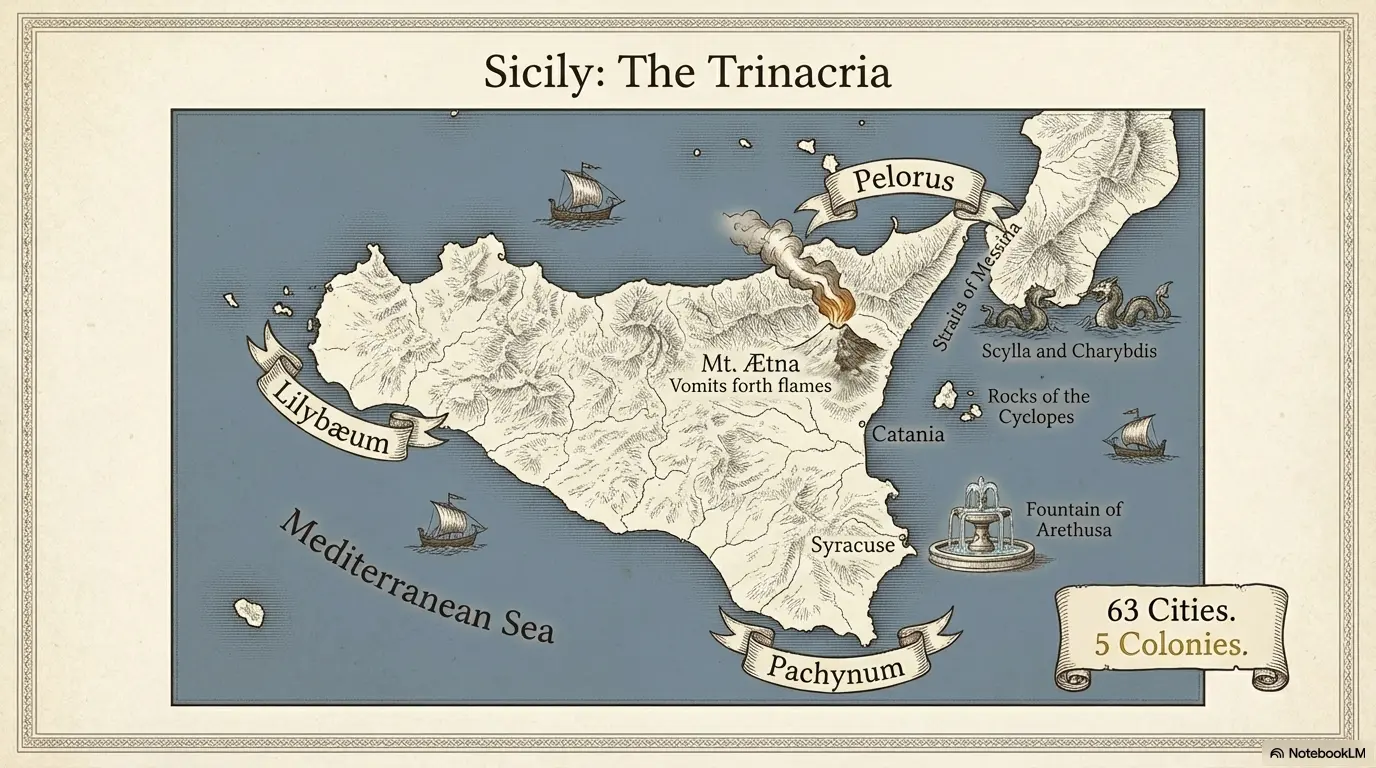
The island's position between Italy and Africa, its harbor approaches and its internal distances recur in the Punic and servile wars. Use the coastal framework to connect separate narratives of Messana, Syracuse and western strongholds. The historical dossier, rather than the decorative scene or ancient city count, governs the military chronology.
Outcome and critical assessment
Result and caution: both revolts were defeated. Most surviving narrative comes through hostile elite traditions, especially the fragmentary transmission of Diodorus. Claims about rebel numbers, cruelty and motives need scrutiny. The two Sicilian wars must remain distinct from Spartacus' later war in mainland Italy.
Historical record: IR-V, Republican crisis context; Diodorus, fragments of books 34–36; campaign tables. The local evidence is uneven and does not support a full day-by-day operational reconstruction.