Legions · The legions, by number
41 Legio XIX
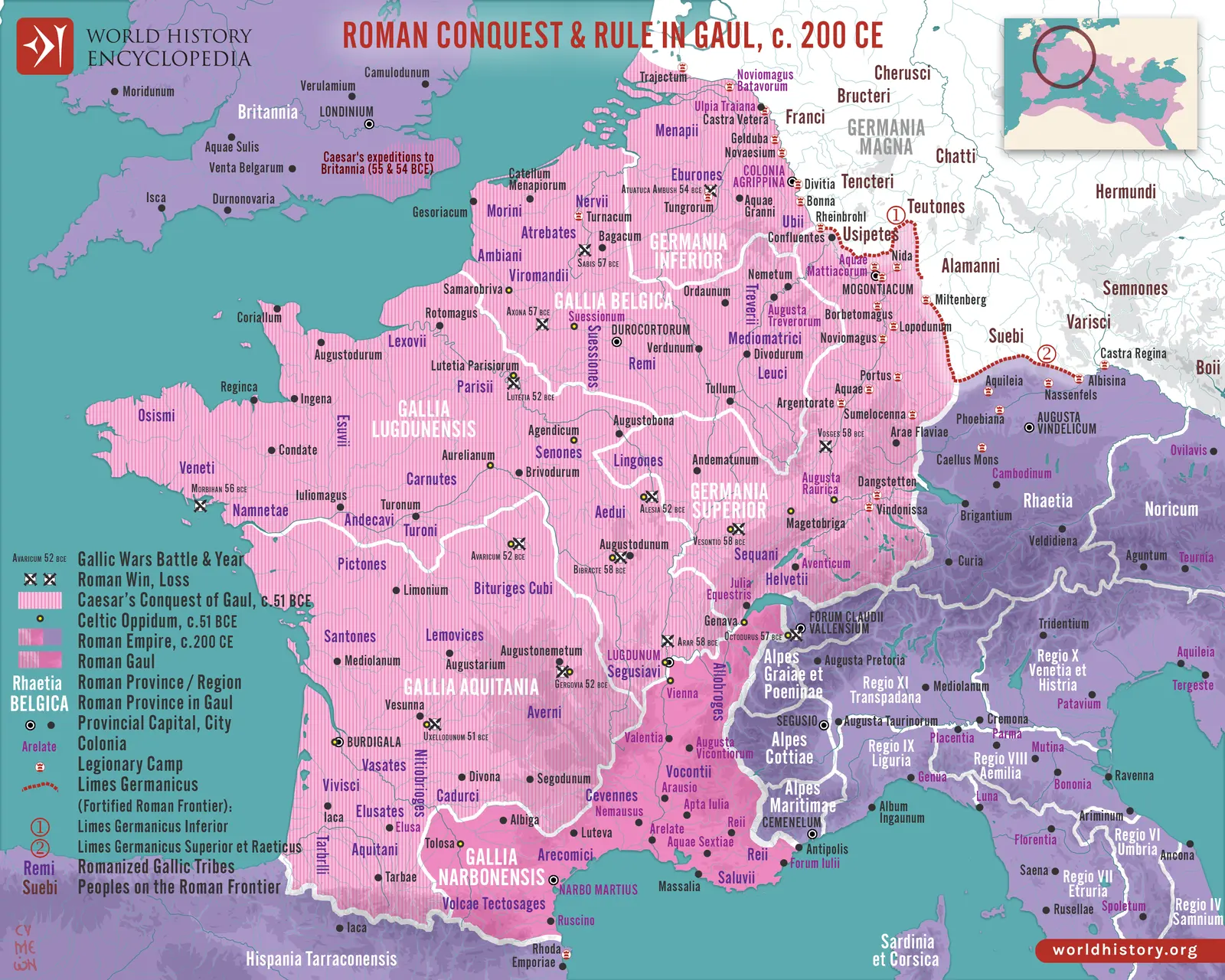
The Nineteenth’s destruction in 9 belongs to the wider failure of Roman occupation and campaigning east of the Rhine. Its individual material traces make its dossier different from XVII’s much thinner one. Nevertheless, a complete pre-disaster marching route or an exhaustive command roster cannot be recovered from these traces alone.
Endpoint: destruction in 9.
Selected chronology
- Civil-war period: probable foundation; precise ancestry uncertain.
- c.15–8 BCE: material association with Dangstetten in the conventional site chronology.
- Augustan period: further service in the German military establishment.
- 9: destruction with the Varian army.
Upper Rhine traces
XIX’s association with the Dangstetten military establishment provides a concrete stage before the final German campaign. Military objects and marked equipment link the legion, or a substantial part of it, with an occupied site. Such evidence has a different scale from a narrative saying that an army marched through a region: it can locate an institution’s material presence without explaining every campaign between two dates.
The regiment’s probable civil-war origin remains separate from that later station evidence. Proposed Octavianic or other antecedents should not be used to fill every missing decade with confident assignments. Its complete surname is not securely established.
Destruction under Varus
The Nineteenth belonged to the army destroyed in 9. The conventional identification of the wider disaster with the Kalkriese landscape does not mean that every maneuver shown on a modern battlefield plan is settled. The extent and sequence of the fighting remain subjects of reconstruction.
The effects extended to the surviving Rhine army. Reinforcement, the protection of provincial approaches, and later campaigns of retaliation were responses to the loss of an entire regional military force. A legion’s destruction therefore changed the duties of other institutions that had not shared its immediate fate.
Institutional ending and imperial memory
The Nineteenth was not re-established as one of the enduring imperial legions. Its number remained associated with the lost army, while monuments, recovered objects, and the stories of later campaigns preserved the event’s memory. The appropriate biography joins its individually recoverable Upper Rhine footprint to the collective catastrophe without inventing a private last stand or a detailed regimental banner. Its historical importance is both military and commemorative: the regiment ended, but the political meaning of its loss endured.