Legions · The legions, by number
08 Legio II Augusta
The Second Augustan Legion
Identity. Usually connected with the civil-war recruitment of 43 BCE; the precise relationship to earlier Second legions remains uncertain. Capricorn and Pegasus are associated badges.
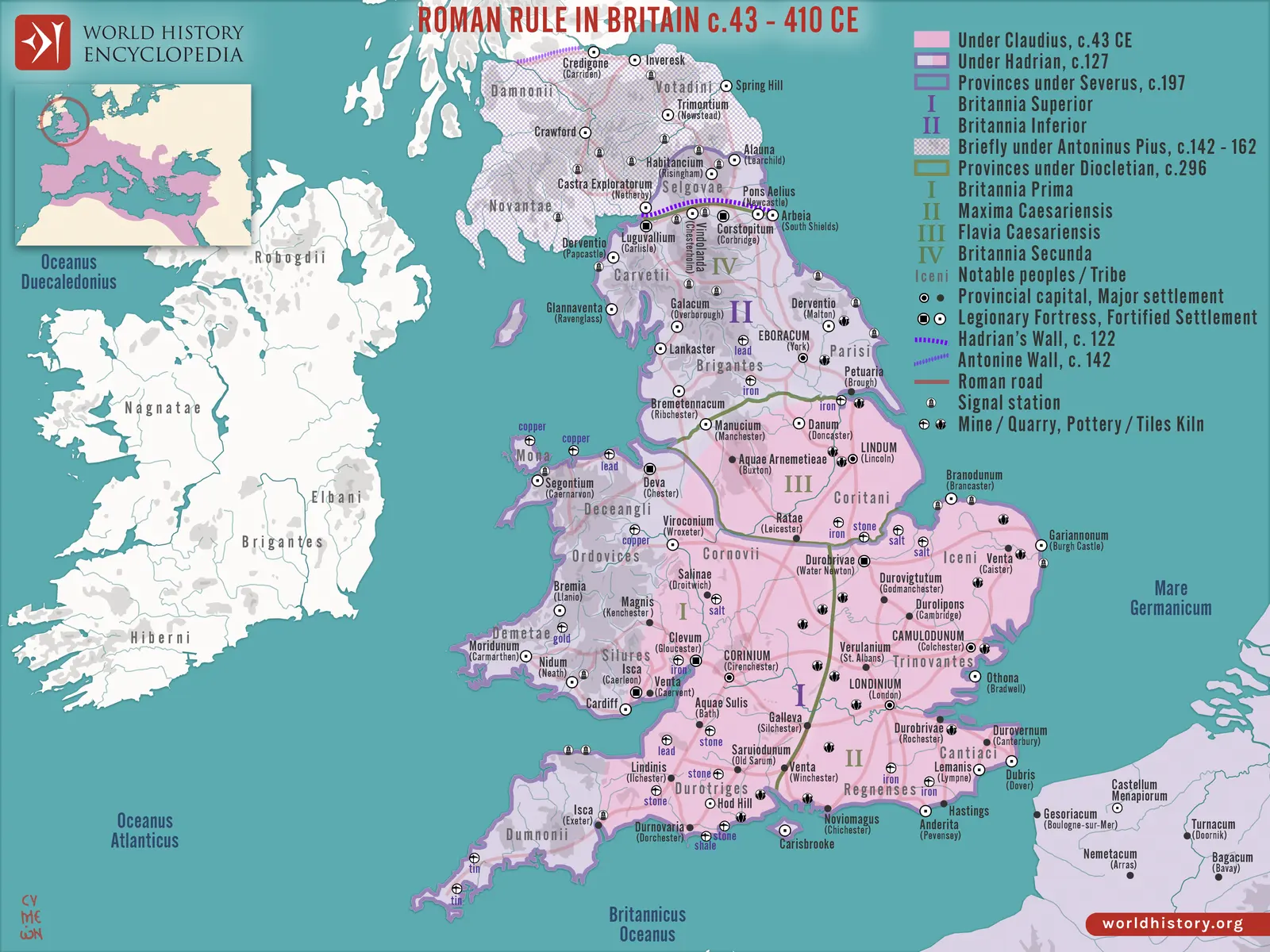
Historical outline. The Second’s long biography links Spain, the Rhine, the invasion of Britain, and the occupation of Wales. Vespasian commanded it during Claudius’ conquest. Caerleon became its best-known fortress, but the late administrative record places the legion at Richborough. The biography is consequently one of both persistent identity and changing operational geography.
Selected chronology
- Augustan–early imperial period: service in Spain and then on the Rhine.
- 43: participation in the invasion of Britain under Vespasian.
- 60/61: absence from Suetonius Paulinus’ decisive battle against Boudicca.
- Flavian period: establishment at Caerleon, conventionally around 75.
- Second century: participation in British frontier works and northern operations.
- Late horizon: late military register listing at Rutupiae/Richborough.
Britain under Vespasian
In 43 the Second crossed to Britain within a combined invasion army. Vespasian’s command connected it with operations in the south and southwest, where river barriers, fortified settlements, and a developing occupation network mattered as much as a decisive pitched battle. The future emperor’s reputation grew from provincial command long before his dynasty’s foundation.
The revolt of Boudicca exposed the fragility of conquest. While Suetonius Paulinus assembled a small field army, II Augusta did not join the decisive battle. The refusal of camp prefect Poenius Postumus to obey the summons became a remembered command failure. His suicide after the Roman victory should be distinguished from the legion’s wider record: one dramatic episode did not fix the behavior of every cohort or the loyalty of every later generation.
Isca and the British frontier
At Caerleon the fortress stood near the Usk, giving access to riverborne supply as well as roads through southern Wales. Barracks, headquarters buildings, baths, storage, and the amphitheater made the legion a powerful consumer and builder. The surrounding settlement included traders, craftspeople, veterans, and families whose lives were inseparable from the military economy.
The Second also supplied labor for northern frontiers. Hadrian’s Wall and the Antonine Wall were collective military projects, not monuments attributable to one regiment alone. Distance slabs on the Antonine line identify II Augusta’s work and present building as an imperial victory over space and people. The Capricorn’s appearance in military imagery served both identification and commemoration.
A changing final geography
The late coastal assignment at Richborough places the legion in a world concerned with sea approaches, ports, and regional defense. It should not be imagined as the full early imperial establishment merely transported intact into one late fort. The Second’s legacy is unusually visible in the landscape: conquest routes, the fortress at Isca, northern building inscriptions, and the final coastal identity together define a history much larger than a single celebrated commander.