Legions · The legions, by number
39 Legio XVII
An Octavianic foundation in the civil-war period is often proposed. Dio’s account of the disaster in Book 56 supports the destruction of a three-legion army; it should not be made to supply individual details absent from the text.
Endpoint: the conventional reconstruction places its destruction in 9.
Selected chronology
- Civil-war period: an Octavianic foundation is the usual reconstruction.
- Augustan period: inferred existence within the Rhine army.
- 9: conventional identification as the third legion lost with Varus.
An unusually difficult institutional identity
The Seventeenth is less individually visible than the other legions conventionally assigned to Varus. Its Augustan existence is reconstructed from the broader roster, the destruction of a three-legion army, and the absence of another plausible missing formation. Earlier Republican legions bearing the numeral do not establish the complete ancestry of this particular unit.
An Octavianic origin during the later civil wars is plausible. Beyond that, a detailed sequence of recruitment districts, first officers, camps, and campaigns would exceed what can be securely recovered. The absence is not a defect to be repaired by copying the histories of XVIII and XIX.
The army in 9
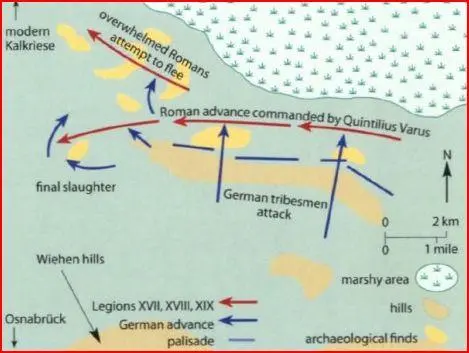
The Varian disaster involved a force moving through contested country with baggage and attached personnel. Difficult ground, hostile preparation, disrupted movement, and the inability to concentrate a battle army were central to the catastrophe. Soldiers accustomed to organized deployment were forced into fighting where formations, communication, and mutual support were much harder to maintain.
The army’s collective destruction does not allow every incident to be assigned to a particular numbered legion. The Seventeenth’s specific place within the marching order, final concentration, or recovery of standards cannot be supplied confidently.
Memory without invented insignia
No secure complete surname or distinctive badge should be created for an illustration. In this atlas the Seventeenth is represented through the general army and campaign landscape rather than a fabricated regimental flag. Its importance lies partly in the boundary it exposes between a strongly supported historical reconstruction and a richly documented institutional biography. The conventional endpoint remains the disaster of 9, with individual details substantially less recoverable than the army’s shared fate.