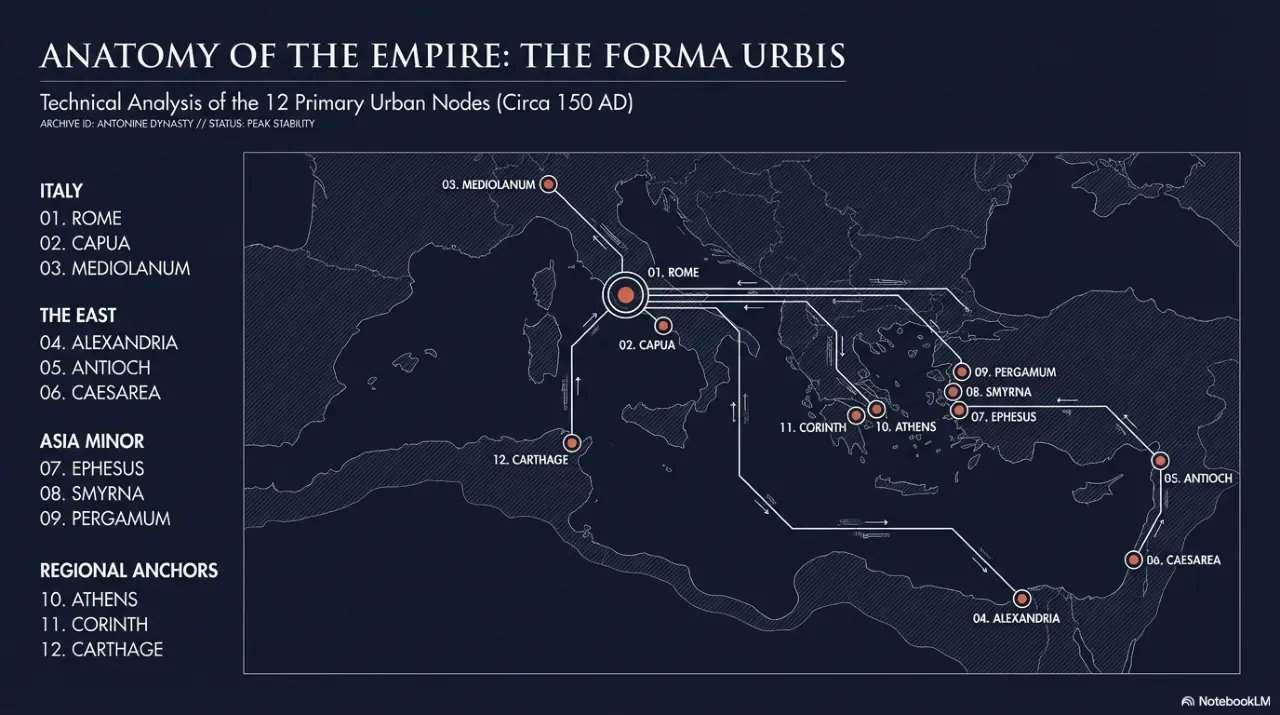
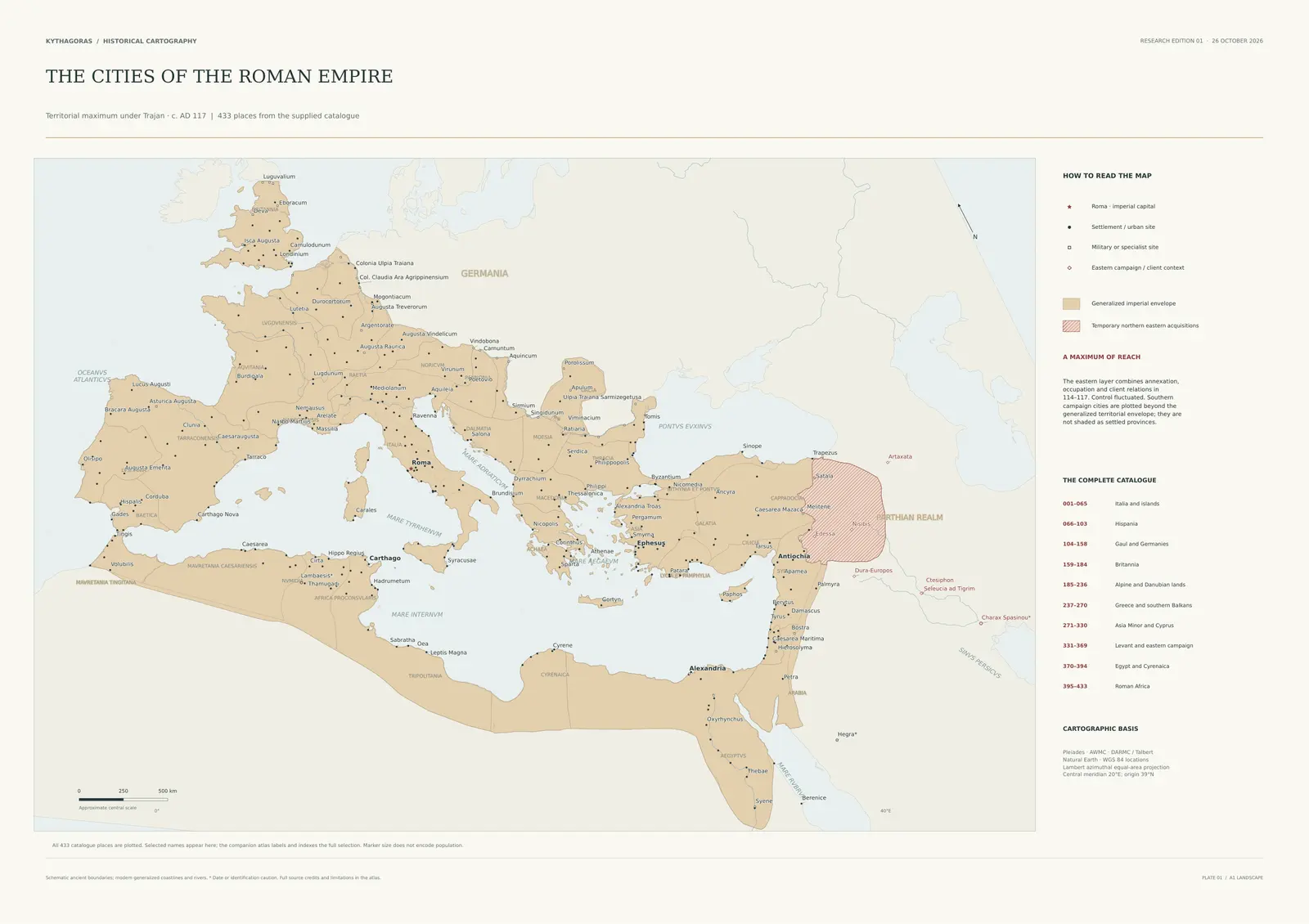
The data
Detailed Chronology of the Nerva-Antonine Succession
In the text Book VII · Chapter 4: The Antonine Noon and Its Wars
| Date | Event | Historical Figure | Key Political Action | Imperial Impact | Source |
|---|---|---|---|---|---|
| A.D. 30–32 | Birth of Nerva | Nerva | Born into a high-ranking senatorial family in Narni. | Established a lineage with high legal and diplomatic service backgrounds; future first of the 'Five Good Emperors'. | 1, 2, 3 |
| A.D. 65 | Pisonian Conspiracy | Nerva, Nero | Nerva revealed the plot against Nero to the emperor. | Awarded triumphal ornaments and a statue; established his utility to the state during the Julio-Claudian era. | 1, 2 |
| A.D. 68 | Introduction of Aequitas on Coinage | Galba | Adoption of rebel themes and Moneta to signal command over public finances. | Communicated honesty in fiscal administration following a period of economic vulnerability. | 4 |
| A.D. 69 | Year of the Four Emperors | Vespasian, Agricola, Mucianus | Vespasian aspires to the empire; Agricola joins his party. | Beginning of the Flavian dynasty after the civil wars of Otho and Vitellius. | 5 |
| A.D. 70 | Imposition of the Fiscus Judaicus | Vespasian | Redirected the half-shekel Temple tax to the Temple of Jupiter Optimus Maximus in Rome. | Replaced the levy for Jerusalem with a tax for Roman religion; served as a significant humiliation for Jews. | 6, 7, 8 |
| A.D. 71 | First Consulship of Nerva | Nerva, Vespasian | Nerva served as joint consul with Vespasian. | Rare honor for a non-family member of the Flavian dynasty; established Nerva as a leader of the senatorial elite. | 1, 2, 9, 3 |
| A.D. 73–76 | Governorship of Aquitania | Agricola | Agricola serves as governor, demonstrating civil administrative precision. | Stabilization of Gallic provinces and preparation of Agricola for the consulate. | 5 |
| A.D. 77 | Consulship and Marriage Alliance | Agricola, Tacitus | Agricola serves as consul and contracts his daughter to the historian Tacitus. | Consolidation of political ties between the military elite and the rising senatorial class. | 5 |
| A.D. 78–84 | Campaigns in Britain | Agricola | Series of military operations including the capture of Mona and the Battle of the Grampian Hills. | Total military submission of Britain is proclaimed; extension of Roman influence into Caledonia. | 5 |
| A.D. 81 | Accession of Domitian | Domitian | Succeeds his brother Titus as emperor. | Beginning of a Flavian era characterized by increasing autocracy and later persecution. | 10 |
| A.D. 81–96 | Reign of Domitian | Domitian | Exercise of autocratic rule, taking the titles 'dominus et deus' and perpetual censorship. | Period marked by the enfeeblement of the Senate, reliance on informers, and a climate of fear. | 10, 11, 4, 12, 13 |
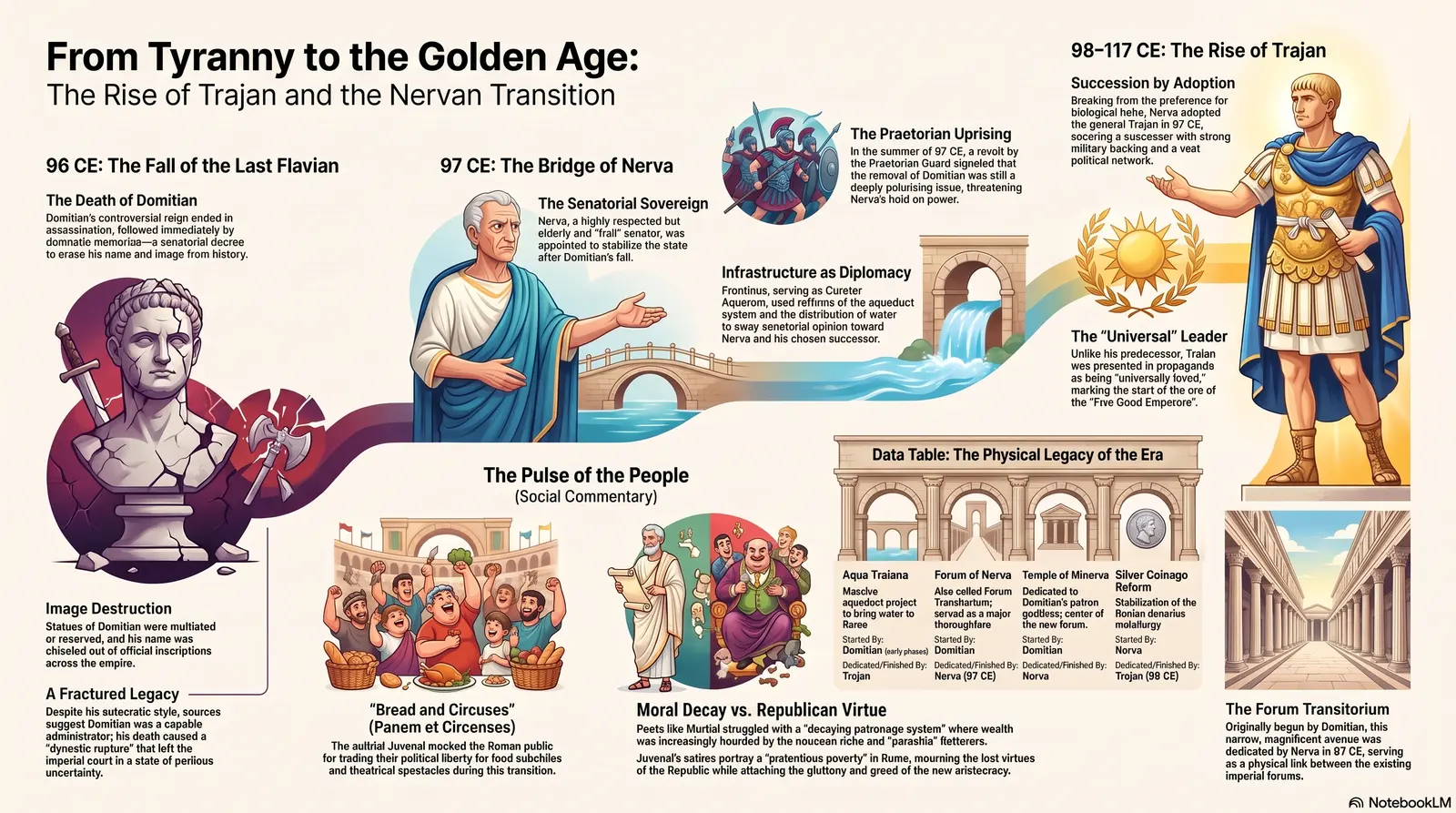
| A.D. 85 | Construction of the Forum Transitorium | Domitian | Commissioned the monumentalization of the Argiletum to connect the older imperial fora. | Initiated a major urban reorganization; aimed to monumentalize Rome after the fires of 80 CE. | 14, 1, 15, 16 |
| A.D. 89–90 | Education and Philosophy Reforms | Domitian, Quintilian | Quintilian receives a state salary; Domitian expels philosophers. | Formalized state-funded education while suppressing political dissent and Stoic opposition. | 10 |
| A.D. 90 | Second Consulship of Nerva | Nerva, Domitian | Nerva shares the ordinary consulship with Domitian. | Maintained political relevance through Flavian regime transitions; likely reward for loyalty. | 1, 2, 3 |
| A.D. 93 | Death of Agricola | Agricola, Domitian | Death of the general; rumored to have been poisoned by the emperor. | Highlighted the conflict between prominent senators and a jealous, autocratic monarch. | 5, 11 |
| Date | Event | Historical Figure | Key Political Action | Imperial Impact | Source |
|---|---|---|---|---|---|
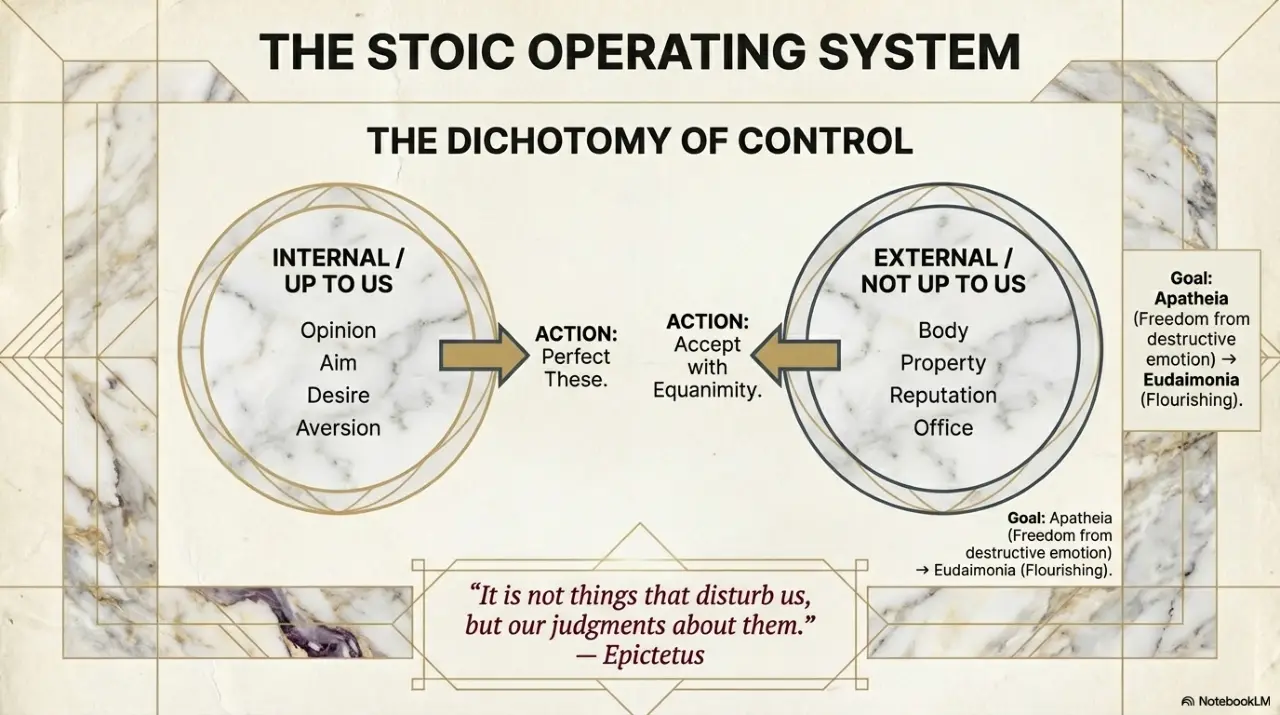
| A.D. 95 | Execution of Flavius Clemens | Titus Flavius Clemens | Put to death for "living a Jewish life" or "atheism." | Highlights the lethal political consequences of practicing Jewish customs during the Domitianic autocracy. | 6, 7 |
| Sept 18, A.D. 96 | Assassination of Domitian | Domitian, Nerva | Domitian is murdered by household staff and palace officials. | End of the Flavian dynasty; immediate meeting of the Senate to appoint a successor. | 10, 17, 18, 11, 19, 14, 20, 1, 21, 15, 2, 9, 22, 23, 3, 24 |
| Sept A.D. 96 | Accession of Nerva | Nerva | Senate proclaimed Nerva emperor; Nerva swears oath not to execute senators. | Transition from Flavian autocracy to the Nerva-Antonine era; restoration of senatorial liberties. | 10, 17, 18, 11, 25, 19, 20, 1, 21, 2, 9, 22, 23, 26, 3, 24 |
| Late A.D. 96 | Reform of the Fiscus Judaicus | Nerva | Abolished "calumnia" (malicious prosecution) regarding the tax. | Eased administrative burdens; coinage minted with "fisci Judaici calumnia sublata" to signal reform. | 4, 6, 7, 8, 24 |
| A.D. 96–97 | Initial Emissions of Coinage | Nerva | Issuance of coins heralding Aequitas, Iustitia, Libertas, and Pax Augusti. | Publicly communicated the transition to a fair and just regime; contrasted with the previous autocracy. | 17, 4, 22, 3 |
| A.D. 96–98 | Nerva's Administrative Reforms | Nerva | Implementation of the Alimenta, inheritance tax exemptions, and land allotments. | Focus on social welfare, economic stabilization, and relieving financial burdens on the needy. | 27, 28, 25, 19, 29, 21, 30, 2, 9, 31, 23 |
| Dec A.D. 96 | Publication of Martial's Book 11 | Martial, Nerva | Literary praise characterizing Nerva as a "second Augustus" or "pious Numa." | Defined the regime's rhetoric as one of restored 'libertas' and Augustan values. | 17, 4, 1, 32 |
| A.D. 97 | Appointment of Water Commissioner | Frontinus, Nerva | Frontinus appointed 'curator aquarum'; implemented maintenance and distribution reforms. | Professionalized infrastructure; restored water rights income to the public; improved efficiency. | 17, 18, 4, 25, 19, 33, 1, 12, 2, 9, 13, 34 |
| Summer A.D. 97 | Mutiny of the Praetorian Guard | Nerva, Casperius Aelianus | Soldiers besieged the palace, demanding the execution of Domitian's assassins. | Exposed Nerva's military vulnerability and forced him to seek a strong successor. | 17, 25, 19, 1, 12, 2, 22 |
| Oct 27, A.D. 97 | Adoption of Trajan | Nerva, Trajan | Nerva adopted Trajan as his son and successor at the Temple of Jupiter. | Secured the succession and stabilized the government with military support; established merit-based succession. | 10, 17, 28, 18, 35, 11, 4, 25, 19, 33, 20, 29, 1, 12, 21, 15, 2, 9, 22, 13, 34 |
| Date | Event | Historical Figure | Key Political Action | Imperial Impact | Source |
|---|---|---|---|---|---|
| A.D. 97–98 | Publication of Technical Treatises | Frontinus | Publication of 'De aquaeductu urbis Romae'. | Highlighted the transition to Trajanic/Nervan justice; established a uniquely Roman scientific culture. | 33, 1, 12, 2, 9 |
| Jan 1, A.D. 98 | Consular Inauguration | Nerva, Trajan | Nerva and Trajan shared the consulship. | Formalized the co-rule and legitimacy of the designated successor. | 19, 2 |
| Jan 27, A.D. 98 | Death of Nerva | Nerva | Natural death of the emperor after a sixteen-month reign. | Peaceful transition to Trajan; marking the beginning of the era of the 'Five Good Emperors'. | 17, 25, 19, 1, 21, 2, 9, 22, 23 |
| A.D. 98 | Accession of Trajan | Trajan | Succession of Trajan at Cologne; assumption of the title 'Optimus'. | Beginning of major imperial expansion and administrative vigor. | 10, 20, 21, 13, 24 |
| A.D. 98 | Publication of the Agricola | Tacitus | Publication of a political biography critiquing the Domitianic regime. | Served as a manifesto for the new imperial aristocracy and a denigration of the predecessor. | 11, 33, 12 |
| A.D. 98–117 | Expansion of the Alimenta | Trajan | Expansion of welfare funding via loans to landowners; interest funded children's subsistence. | Used as a propaganda tool to showcase imperial 'liberalitas' and bind the emperor to Italy. | 27, 29, 30, 31 |
| A.D. 100 | Trial of Marius Priscus | Trajan, Pliny, Tacitus | Impeachment of the proconsul of Africa for extortion before the Senate. | Strengthening of provincial administration and anti-corruption measures. | 10, 11 |
| A.D. 100 | Delivery of the 'Panegyricus' | Pliny the Younger | Public speech praising Trajan's virtues and contrasting him with Domitian. | Defined the ideological shift from tyranny to 'civilitas' and the return of the rule of law. | 28, 35, 4, 33, 36, 29, 1 |
| c. A.D. 100 | Publication of Juvenal's Satires | Juvenal | Literary critique of Roman decadence and social change. | Provides a source of social commentary on the transition from Flavian to Nerva-Antonine culture. | 18, 37, 34 |
| A.D. 101–106 | Dacian Wars | Trajan, Decebalus | Military campaigns resulting in the annexation of Dacia. | Secured rich gold mines and led to the empire's maximum territorial extent. | 25, 20 |
| A.D. 104–112 | Careers of Pliny and Tacitus | Pliny the Younger, Tacitus | Service as imperial legates, proconsuls, and in the judicial council. | Illustrates the administrative roles held by the senatorial class under the new dynasty. | 35, 11, 36 |
| A.D. 113 | Dedication of Trajan's Column | Trajan | Erection of the column commemorating Dacian victories. | Monumental celebration of imperial power and expansion; represented significant urban engineering. | 10, 25 |
| A.D. 114–116 | Parthian Campaign | Trajan | Annexation of Armenia and capture of Ctesiphon. | Temporary expansion to the Persian Gulf; Trajan awarded the title 'Parthicus'. | 25 |
| A.D. 117 | Accession of Hadrian | Trajan, Hadrian | Death of Trajan; Hadrian succeeds. | Shift from aggressive expansion to consolidation of the Roman frontiers. | 10, 18, 25, 20 |
| A.D. 122 | Construction of Hadrian's Wall | Hadrian | Beginning of defensive fortifications in Britannia. | Established permanent border fortifications at the northern limit of the empire. | 20 |
| A.D. 138–180 | Later Nerva-Antonine Emperors | Antoninus Pius, Marcus Aurelius | Continued administration of social programs and Stoic leadership. | High point of imperial stability before the eventual murder of Commodus in $192$ CE. | 27, 20 |