The Capstone · Across the eight volumes
Infographic · C-G01
THE INSTRUMENT, 390 BC–AD 476
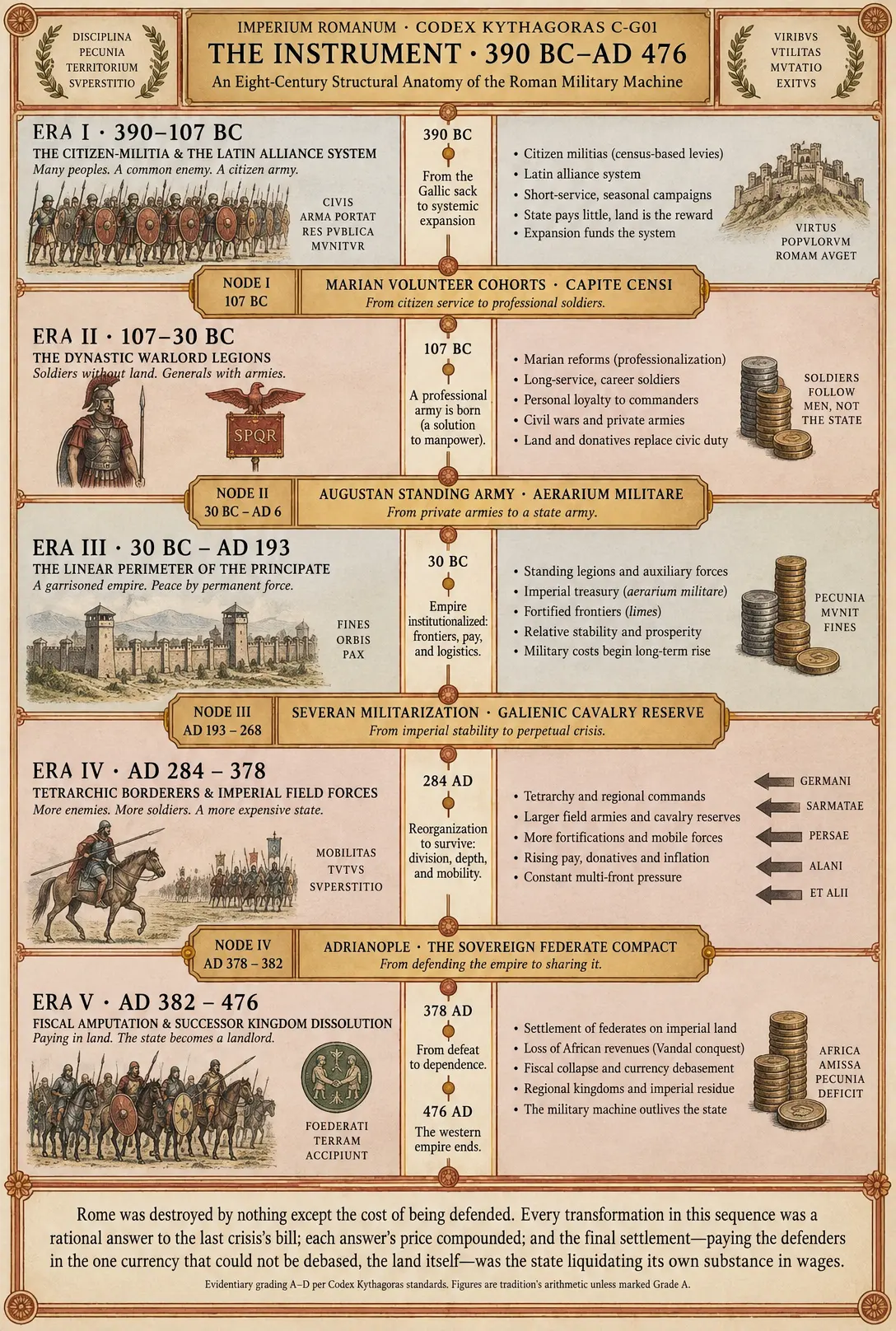
Infographic C-G01: The complete eight-century structural evolution and fiscal liquidation of the Roman military instrument from the Allia to the deposition of Romulus Augustulus (390 BC–AD 476).
INFOGRAPHIC DESIGN BRIEF: C-G01
"THE INSTRUMENT, 390 BC–AD 476: An Eight-Century Structural Anatomy of the Roman Military Machine"
1. Executive Purpose & Editorial Thesis
This master infographic charts the eight-hundred-year institutional evolution of the Roman military instrument from the post-Allia citizen levy to the dissolution of the Western empire in AD 476. It synthesizes the central military thesis articulated across Books I–VIII of IMPERIUM ROMANUM: Rome was not destroyed by military failure, but by the compounding cost of its own defense. Every structural transformation was an operationally rational response to an immediate crisis; each solution created fiscal, political, or demographic liabilities; and the final phase—federate settlement via hospitalitas—represented the state liquidating its own tax base to pay its defenders in land.
All historical claims, figures, and institutional milestones carry their formal Codex Kythagoras attestation grades (A–D).
2. Series Palette & Typographic Register
- Background Canvas: Warm Antique Cream (
#F4EBD5) - Roman State / Legionary Authority: Tyrian Crimson (
#8B1A1A) - Opponents / Frontier Pressure / Unreconciled Foes: Iron-Grey (
#4A4A4A) - Fiscal Amputation / Tribute / Booty / Debased Currency: Punic Ochre (
#B5824A) - Federate Kingdoms / Client States / New Sovereignties: Bronze-Green (
#5A6B3A) - Maritime / River Boundaries / Frontier Waters: Pale Aegean Blue (
#A4C2D9) - Architectural Frames / Cartouches / Rules: Terracotta (
#A85638) - Imperial Dignity / Monumental Labels / Captions: Muted Gold (
#B89954) - Typography: Clean classical Roman inscriptional serif capitals (Trajan/Cinzel register) for titles and dates; crisp transitional serif (Baskerville/Caslon register) for analytical notes and institutional definitions; italicized serif for Latin technical terminology and source qualifications.
3. Layout Architecture (Vertical 2:3 Axis)
The infographic is structured as a single continuous vertical spine representing chronology (390 BC at top, AD 476 at base). Five horizontal Era Bands depict the stable operational models, punctuated by four prominent Transformation Nodes that mark systemic ruptures. Flanking columns display shifting recruitment pools, logistical mechanisms, and attestation grades.
+-------------------------------------------------------------------+
| HEADER CARTOUCHE: Series Title, Asset ID, Scope & Central Thesis  |
+-------------------------------------------------------------------+
| ERA BAND I: The Citizen-Militia & Latin Alliance (390–107 BC)    |
+-------------------------------------------------------------------+
| [NODE 1: 107 BC] The Marian Shift: Capite Censi & Client Armies   |
+-------------------------------------------------------------------+
| ERA BAND II: The Dynastic Warlord Legions (107–30 BC)             |
+-------------------------------------------------------------------+
| [NODE 2: 30 BC–AD 6] The Augustan Standing Nationalization        |
+-------------------------------------------------------------------+
| ERA BAND III: The Linear Frontier of the Principate (30 BC–AD 193)|
+-------------------------------------------------------------------+
| [NODE 3: AD 193–268] Severan Militarization & Gallienic Mobile Arm|
+-------------------------------------------------------------------+
| ERA BAND IV: Tetrarchic Borderers & Field Armies (AD 284–378)     |
+-------------------------------------------------------------------+
| [NODE 4: AD 378–382] Adrianople & The Sovereign Federate Compact  |
+-------------------------------------------------------------------+
| ERA BAND V: Fiscal Amputation & Successor Dissolution (382–476)   |
+-------------------------------------------------------------------+
| FOOTER PANEL: The Master Accounting Theorem & Source Ledger       |
+-------------------------------------------------------------------+
4. Panel-by-Panel Content & Verbatim Labels
[Header Block]
- Title Cartouche (Gold on Terracotta):
"IMPERIUM ROMANUM · CODEX KYTHAGORAS C-G01" - Primary Title:
"THE INSTRUMENT · 390 BC–AD 476" - Subtitle:
"An Eight-Century Structural Anatomy of the Roman Military Machine" - Thesis Ledger Line:
"From the Allia to Ravenna: How the Defense of the World-State Liquidated Its Own Substance"
[Era Band I: 390–107 BC]
- Header:
"ERA I · THE CITIZEN-MILITIA & THE LATIN MANPOWER ENGINE (390–107 BC)" - Tactical Formation: Manipular Legion (triplex acies: hastati, principes, triarii). Abandonment of hoplite phalanx after Allia. Introduction of scutum, pilum, and flexible cohort articulation.
- Social Basis: Propertied assidui (census qualification). Campaign militia disbanded at season close.
- Strategic Engine: The Latin Settlement of 338 BC (
[AGrade A epigraphy / BGrade B narrative]). Bilateral treaties with socii generating an allied manpower reserve of 700,000+ men by 225 BC (Polybius 2.24[AGrade A document]). Rome absorbs catastrophic casualties (Cannae: 45,000–55,000 dead[AGrade A]) through demographic replacement without state fiscal collapse. - Structural Friction: Prolonged Mediterranean overseas service (Spain, Greece, Asia) destroys Italian smallholder class; rise of slave-run latifundia narrows the recruiting census base.
[Transformation Node 1: 107 BC]
- Node Marker (Terracotta Framed Cartouche):
"TRANSFORMATION NODE I · 107 BC · THE MARIAN MUTATION" - Mechanism: Marius enrolls the capite censi (propertied qualification abolished; volunteers below census threshold armed at state expense)
[BGrade B process / AGrade A statutory references]. - Organizational Standard: Cohort of 600 becomes sole tactical unit; 10 cohorts per legion (approx. 5,000–6,000 men). Baggage consolidated onto soldiers (muli Mariani); silver eagle (aquila) made supreme cult standard.
- The Compounding Cost: The legion becomes a permanent socio-economic livelihood. Soldiery depends entirely upon its commander to extract post-service land allotments and cash donatives from the political assembly. The client army is born.
[Era Band II: 107–30 BC]
- Header:
"ERA II · THE DYNASTIC WARLORD LEGIONS (107–30 BC)" - Tactical Formation: Cohortal legion; rapid maneuver, veteran shock-wedges; massive civil war concentrations (Pharsalus, Philippi: 80,000+ per side).
- Social Basis: Landless urban and rural poor bound by military oath (sacramentum) to individual dynasts (Sulla, Pompey, Caesar, Antony, Octavian).
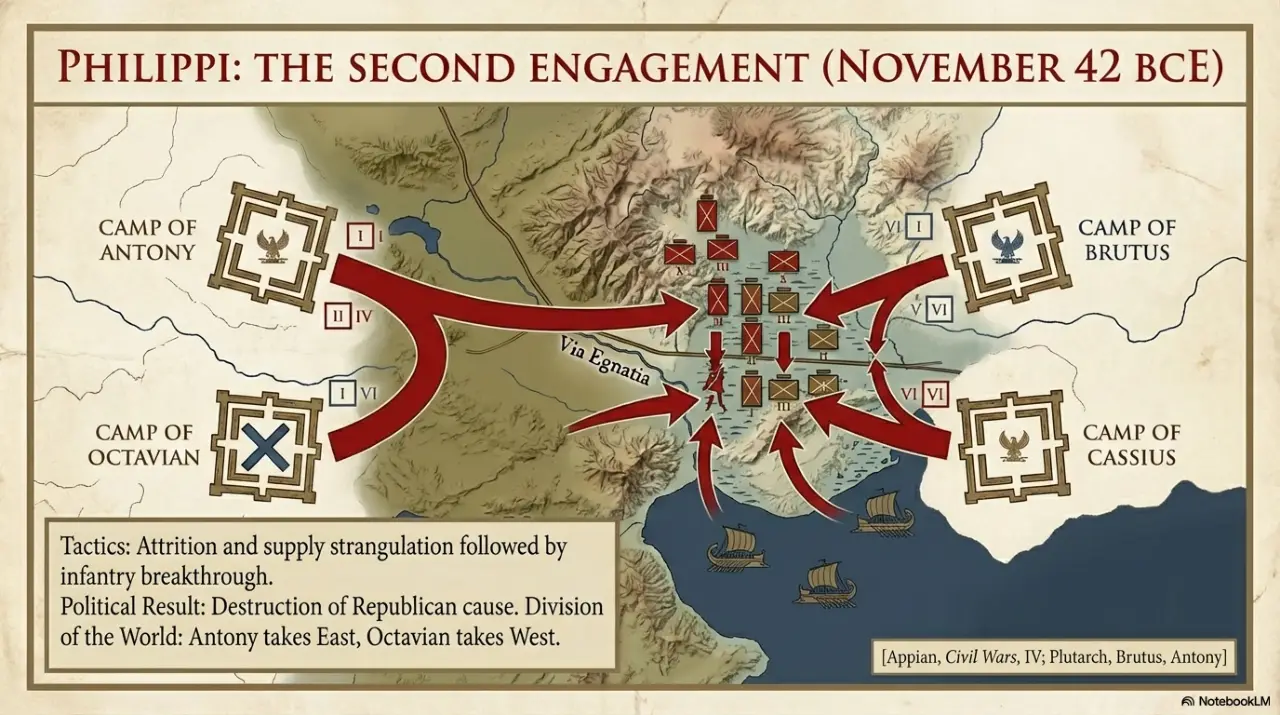
- Systemic Breakdown: Armed march on Rome becomes recurring political tool (Sulla 88 BC
[BGrade B], Caesar 49 BC[AGrade A], Octavian 43 BC[AGrade A]). Republic devoured by its own defenders. Proscriptions used as fiscal instruments to pay military bonuses.
[Transformation Node 2: 30 BC–AD 6]
- Node Marker (Terracotta Framed Cartouche):
"TRANSFORMATION NODE II · 30 BC–AD 6 · THE AUGUSTAN NATIONALIZATION" - Mechanism: Augustus nationalizes military patronage. Sole imperator holds all frontier provinces and legions in perpetuity.
- Establishment Parameters: Fixed standing force of 28 legions (reduced to 25 after Teutoburg, AD 9
[AGrade A]). Service terms fixed at 16, then 20 years. Dedicated military treasury (aerarium militare, AD 6[AGrade A]) funded by inheritance and sales taxes. Professional auxiliary corps (auxilia) awarded citizenship via bronze diploma upon honorable discharge[AGrade A epigraphy]. Praetorian Guard established at Rome as imperial bodyguard. - The Compounding Cost: The arcanum imperii (AD 69
[AGrade A]): "Emperors could be made elsewhere than at Rome." Dynastic survival tied to competitive accession donatives.
[Era Band III: 30 BC–AD 193]
- Header:
"ERA III · THE LINEAR PERIMETER OF THE PRINCIPATE (30 BC–AD 193)" - Tactical Formation: Hardened linear defense (limes, turf/stone ramparts, Hadrian's Wall
[AGrade A], watchtowers). 28 to 30 legions permanently garrisoned in stone fortresses along Rhine, Danube, Euphrates. - Force Ratio: Approx. 300,000–350,000 soldiers holding an empire of 60,000,000 (1 soldier per 200 civilians)
[Order-of-magnitude estimate]. - Structural Friction: Complete lack of strategic depth. A continuous cordon defense cannot respond to simultaneity. Proven by the Marcomannic Wars (166–180
[BGrade B]): Antonine Plague gaps the ranks while northern invaders breach the perimeter to reach Italy (Aquileia, 170).
[Transformation Node 3: AD 193–268]
- Node Marker (Terracotta Framed Cartouche):
"TRANSFORMATION NODE III · AD 193–268 · SEVERAN MILITARIZATION & THE MOBILE HORSE" - Mechanism: Septimius Severus (
"Enrich the soldiers, despise everyone else"[BGrade B]): legionary pay increased, marriage ban lifted (ius conubii creating rooted vici communities outside camps[AGrade A]), senatorial command eroded in favor of equestrian professionals. - Tactical Mutation (Gallienus, 260–268): Creation of central mobile cavalry field army (equites) based at Mediolanum
[BGrade B]; complete exclusion of senators from military command. - The Compounding Cost: Currency debasement (denarius drops to ~50% silver under Severus, collapses under Gallienus
[AGrade A metallurgy]). Third-Century Crisis (235–284[AGrade A material / BGrade B narrative]): 20+ emperors in 50 years. Armies fight one another for purple while frontiers collapse.
[Era Band IV: AD 284–378]
- Header:
"ERA IV · TETRARCHIC BORDERERS & IMPERIAL FIELD FORCES (AD 284–378)" - Tactical Formation: Institutional division into static border garrison (limitanei / ripenses) and mobile field armies (comitatenses / palatini) under magistri militum
[AGrade A documents: Notitia Dignitatum, legal codes]. - Logistical Basis: State arms factories (fabricae); direct requisition in kind (annona militaris); debased coinage replaced by gold solidus.
- Force Geography: Frontier held by fortified burgi and bridgeheads; imperial strike-armies concentrated near key hubs (Trier, Milan, Sirmium, Antioch).
- Structural Friction: Manpower shortages require increasing recruitment of external barbarians (Franks, Alamanni, Goths, Sarmatians) as regular recruits and whole treaty-units (laeti).
[Transformation Node 4: AD 378–382]
- Node Marker (Terracotta Framed Cartouche):
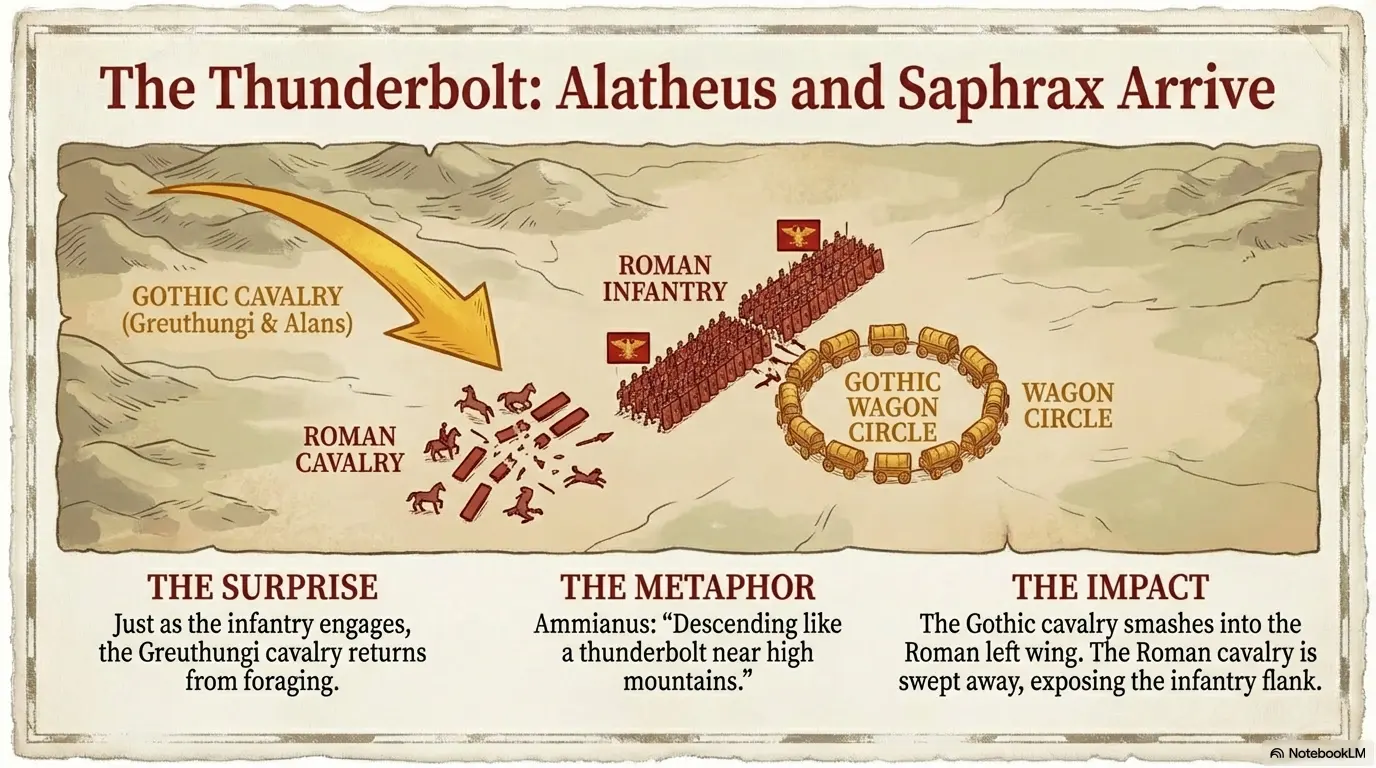
"TRANSFORMATION NODE IV · AD 378–382 · ADRIANOPLE & THE SOVEREIGN FEDERATE COMPACT" - Mechanism: Battle of Adrianople (9 Aug 378
[AGrade A]): 2/3 of eastern field army destroyed; Emperor Valens killed. Treaty of 382 ([BGrade B]): Theodosius settles Visigoths in Thrace not as disarmed individuals, but as an intact armed nation under their own chieftains (foederati).
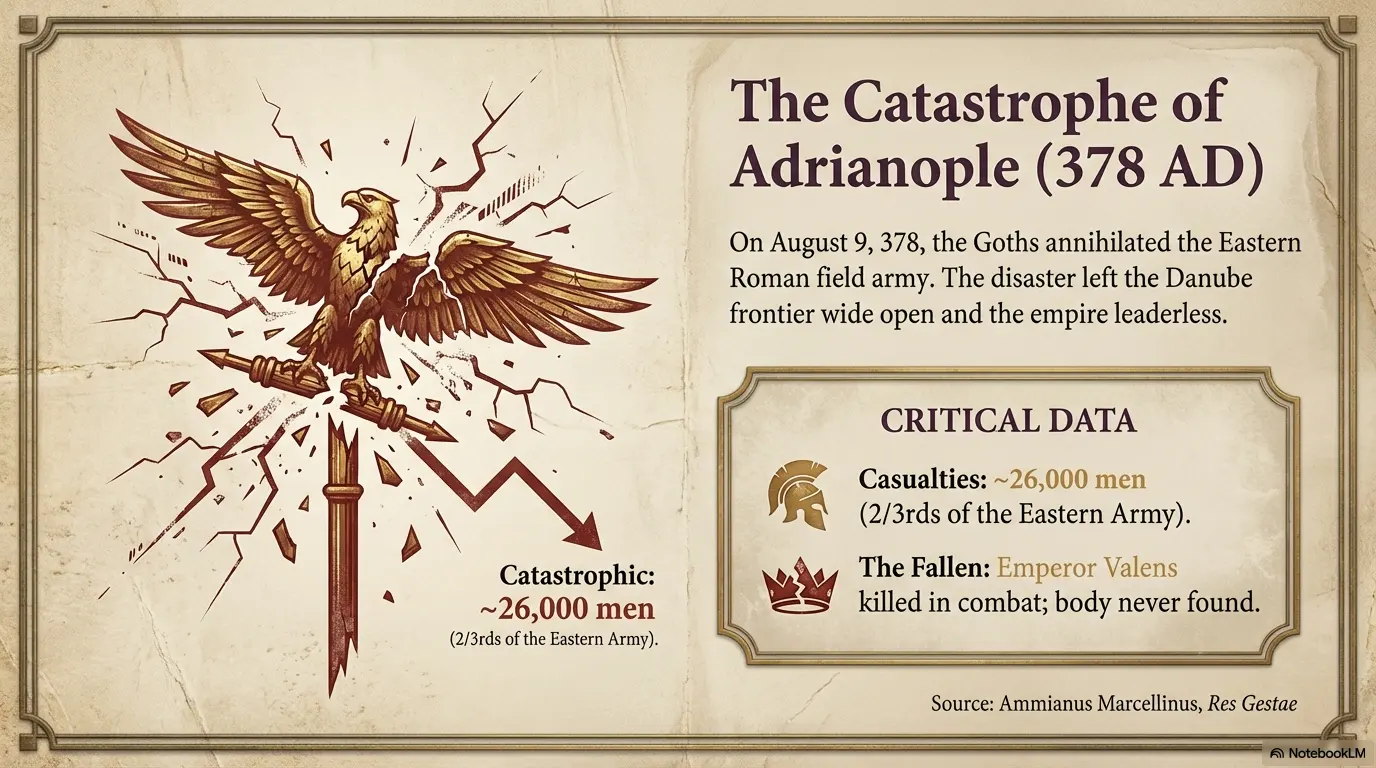
- The Fatal Precedent: A sovereign, armed barbarian polity established intra limitem, paid annual subsidies in gold and fighting under its own royalty.
[Era Band V: AD 382–476]
- Header:
"ERA V · FISCAL AMPUTATION & SUCCESSOR KINGDOM DISSOLUTION (AD 382–476)" - Strategic Reality: Rhine crossing (406
[AGrade A hoards]); Sack of Rome (Alaric, 410[AGrade A]); Visigothic settlement in Aquitaine via hospitalitas (418[BGrade B]). - The Death Wound: Gaiseric seizes Carthage (439
[AGrade A]). Loss of the North African agricultural tax base deprives the Western empire of its liquid revenue ("scarcely to be believed"— Valentinian III, Novels[AGrade A]). Disastrous failures of recovery armadas at Cartagena (461[BGrade B]) and Cape Bon (468[BGrade B]). - The Terminal Mutation: Without cash taxes, Ravenna can pay its armies only in land. The Western field army converts into regional barbarian successor kingdoms (Visigothic, Burgundian, Frankish, Vandal, Odoacer's Italian federates).
- The Deposition (4 Sept 476
[AGrade A]): Odoacer deposes Romulus Augustulus, pensions him at the Lucullan villa, and returns the imperial regalia to Constantinople with the formal notice: "One emperor suffices for both parts."
[Footer Panel: The Master Theorem & Attestation Summary]
-
Primary Text Box (Gold on Cream with Terracotta Double Border):
"THE THEOREM OF THE EIGHT HUNDRED YEARS: Rome was destroyed by nothing except the cost of being defended. Every transformation in this sequence was a rational answer to the last crisis's bill; each answer's price compounded; and the final settlement—paying the defenders in the one currency that could not be debased, the land itself—was the state liquidating its own substance in wages. The successor kingdoms were not the empire's conquerors; they were its army, paid off and gone into business for itself."— Imperium Romanum, Book VIII Epilogue -
Attestation Scale Reference Strip (Bottom Rule):
"EVIDENTIARY ARCHITECTURE: AGrade A (Contemporary documents, inscriptions, archaeology, coins) · BGrade B (Reliable retrospective narrative: Polybius, Ammianus, Tacitus, Appian) · CGrade C (Epitomators, Kaisergeschichte, late chronicles) · DGrade D (Suspect attribution, Historia Augusta fictions, rhetorical ornament). Figures cited are the tradition's arithmetic unless marked AGrade A."
5. Exact Metric & Milestone Ledger for Graphic Plotting
- 390 BC: Allia & Servian Walls. Hoplite phalanx broken.
[BGrade B] - 338 BC: Latin Settlement. Bilateral allied manpower engine (socii).
[AGrade A/B] - 216 BC: Cannae. 45,000–55,000 dead absorbed without political capitulation.
[AGrade A] - 107 BC: Marian Volunteers. Capite censi enrolled; cohortal tactical system.
[BGrade B/A] - 88 BC: Sulla marches on Rome with six legions from Nola.
[BGrade B] - 49 BC: Caesar crosses Rubicon with Legio XIII. Client army supersedes Senate.
[AGrade A] - 30 BC–AD 6: Augustan standing force: 28 legions, aerarium militare, auxilia diplomas.
[AGrade A] - AD 9: Teutoburg Disaster. Three legions erased (XVII, XVIII, XIX); Elbe abandoned.
[AGrade A] - AD 69: Arcanum imperii revealed. Four emperors acclaimed across four frontiers.
[AGrade A] - AD 122–128: Hadrian's Wall & Lambaesis drill addresses (Disciplina Augusti).
[AGrade A] - AD 166–180: Marcomannic Wars & Antonine Plague. Perimeter breached to Italy.
[BGrade B/A] - AD 193–212: Severan military pay rise, marriage legalized, citizenship universalized.
[AGrade A] - AD 260: Valerian captured by Shapur; Gallienus builds Mediolanum mobile cavalry.
[AGrade A/B] - AD 271: Aurelian begins Rome's 19-kilometer defensive wall (Restitutor Orbis).
[AGrade A] - AD 284–305: Diocletianic Tetrarchy; limitanei and comitatenses established.
[AGrade A] - AD 378: Adrianople. 2/3 of eastern field army destroyed by Gothic coalition.
[AGrade A]
- AD 382: Theodosian Gothic Treaty. Sovereign armed nation settled intra limitem.
[BGrade B] - AD 406: Rhine crossing. Frontier permanently unsealed.
[AGrade A hoards] - AD 410: Alaric sacks Rome after three sieges.
[AGrade A] - AD 439: Vandals take Carthage; Western tax-base fatally amputated.
[AGrade A] - AD 476: Romulus Augustulus pensioned; Odoacer remits regalia to Constantinople.
[AGrade A/B]
Image prompt (2:3)
A museum-grade vertical architectural infographic titled "THE INSTRUMENT · 390 BC–AD 476: An Eight-Century Structural Anatomy of the Roman Military Machine", designed in the high-scholarly historical-atlas register (Putzger and Shepherd style crossed with nineteenth-century antiquarian engraved plate aesthetics). The entire composition is set on an antique warm cream parchment background (#F4EBD5) enclosed by an ornate terracotta (#A85638) border with corner rosette bosses and clean double-ruled inner lines. At the top, a prominent gold (#B89954) cartouche with crisp Roman inscriptional serif typography reads: "IMPERIUM ROMANUM · CODEX KYTHAGORAS C-G01" and "THE INSTRUMENT · 390 BC–AD 476". A vertical chronological timeline spine runs down the center, flanked by five distinct horizontal Era Bands washed in subtle tinted tones, each banded by fine terracotta rules: Era I (390–107 BC) "THE CITIZEN-MILITIA & THE LATIN ALLIANCE SYSTEM", Era II (107–30 BC) "THE DYNASTIC WARLORD LEGIONS", Era III (30 BC–AD 193) "THE LINEAR PERIMETER OF THE PRINCIPATE", Era IV (AD 284–378) "TETRARCHIC BORDERERS & IMPERIAL FIELD FORCES", and Era V (AD 382–476) "FISCAL AMPUTATION & SUCCESSOR KINGDOM DISSOLUTION". Across the spine cut four distinct horizontal Transformation Nodes framed in terracotta with gold cartouche tabs: Node I at 107 BC labeled "MARIAN VOLUNTEER COHORTS · CAPITE CENSI", Node II at 30 BC–AD 6 labeled "AUGUSTAN STANDING ARMY · AERARIUM MILITARE", Node III at AD 193–268 labeled "SEVERAN MILITARIZATION · GALLIENIC CAVALRY RESERVE", and Node IV at AD 378–382 labeled "ADRIANOPLE · THE SOVEREIGN FEDERATE COMPACT". Key technical glyphs and symbols appear at measured intervals: small crimson (#8B1A1A) legionary eagle-standards, bronze-green (#5A6B3A) federate settlement discs, Punic-ochre (#B5824A) coin-stacks showing silver debasement and African revenue loss, iron-grey (#4A4A4A) barbed pressure arrows, and tiny fortified wall-profiles. At the bottom, a formal horizontal footer block framed in terracotta contains the verbatim master theorem in dark serif lettering: "Rome was destroyed by nothing except the cost of being defended. Every transformation in this sequence was a rational answer to the last crisis's bill; each answer's price compounded; and the final settlement—paying the defenders in the one currency that could not be debased, the land itself—was the state liquidating its own substance in wages." Beneath it, a microscopic citation line reads: "Evidentiary grading A–D per Codex Kythagoras standards. Figures are tradition's arithmetic unless marked AGrade A." Clean, balanced, mathematically aligned layout, absolutely legible text, no modern digital artifacts, no pseudo-Latin gibberish, no extraneous pictorial illustrations.
C-G01 · generated by the Imperium factory studio (gemini-3.8-flash) from all eight volumes under the House Preamble.